Clearwater does not get a real winter, but it gets cool snaps, a few nights where temperatures drop into the forties or fifties after a cold front pushes through. That drop is enough. Mice and rats that spent the year outside around Crest Lake Park or the Alligator Creek corridor start testing houses for a warmer place to sit out the cold.
What a mouse needs versus a roof rat
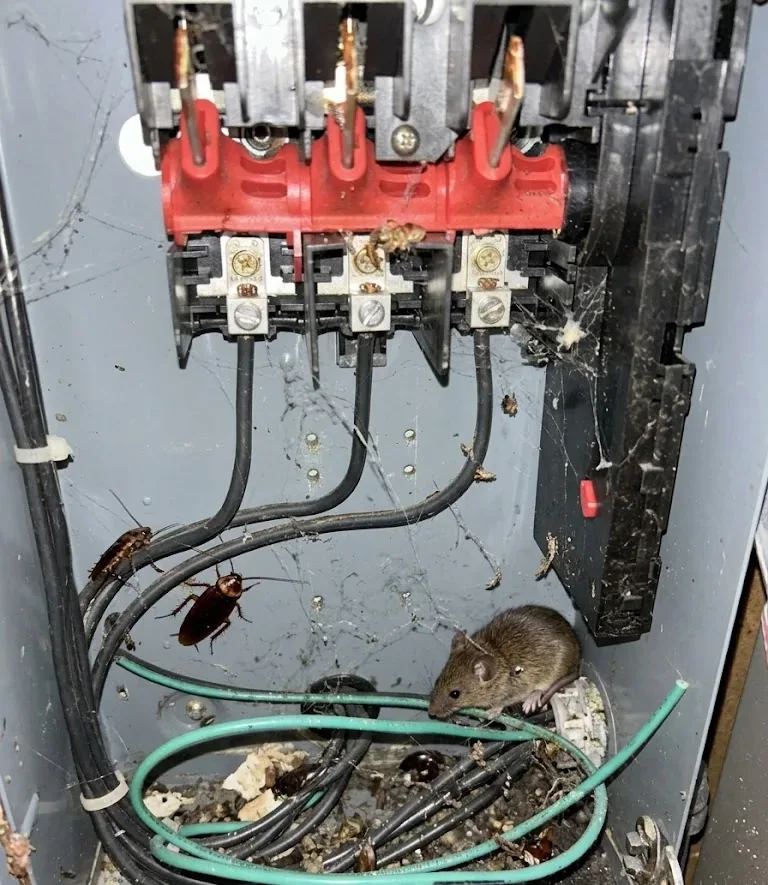
A house mouse only needs a fingernail-sized crack to get inside, usually where a stucco wall meets the slab or where a utility line enters near the AC pad. Roof rats work higher up, along soffits and roofline near Clearwater's tile and shingle homes, using oak branches or power lines as a bridge to reach a gap under the fascia.
The entry points on a slab house
On a slab house, the entry points are almost always in the same handful of spots. Gaps where pipes and electrical lines pass through the slab or exterior wall, torn weatherstripping under garage and exterior doors, and open soffit vents or broken roof tiles near the eaves. None of it is a basement problem, because there is no basement here, it is all at ground level or on the roof.
Roof rats work the roofline, not the ground
Roof rats are the bigger issue for Clearwater specifically, because they do not need a ground-level gap at all. A rat that reaches a roofline near Harbor Oaks or Morningside can get into a house through a gap where a roofline meets a wall, a loose ridge tile, or an uncapped vent stack, entry points a mouse would never even reach.
Why one rodent becomes several
Once a mouse or rat gets past the exterior, it does not need much else to stay. A gap behind a kitchen cabinet, a wall void near a water heater, or insulation in an attic above Del Oro Groves or North Greenwood is enough shelter. A single cool front can be the reason one gets in, but a house that stays warm and dry inside is the reason it does not leave once the weather warms back up.
Why a trap alone does not hold
Setting traps without closing off how they got in just resets the problem. A new mouse or rat finds the same gap near the soffit or slab within days, especially once a cool front pushes more of them to look for shelter around Clearwater homes. Sealing first, then trapping, actually breaks the cycle.
Sealing is what actually stops it
Sealing is what actually stops the cycle: closing slab penetrations, fixing door sweeps, screening soffit vents, and capping roof gaps with materials a rodent cannot chew through, like steel mesh around pipe entries. Trapping clears out what is already inside. Sealing is what keeps the next cool front from turning into the same call again.
Dealing with this in your home?
Rainy season floods yards from Countryside to Sand Key, and pests move indoors the moment ground gets wet. If your Clearwater address keeps ending up on this list, get someone to look before signing a lease or a repair estimate. Dial (727) 558-4422 and describe what you're seeing; that's usually enough to know the next step.